
Becoming a Stay-at-Home Dad in the UK: Money, Mental Health and What to Expect
What should you consider before becoming a stay-at-home dad?
Before becoming a stay-at-home dad in the UK, work out whether your household can manage on one main income, how leaving work could affect your pension and career, and what support you may be entitled to. Emotionally, prepare for changes to your identity, relationship, routine and amount of adult contact.
That is the sensible answer.
The honest answer is that a spreadsheet can tell you whether the bills add up, but it cannot tell you how it will feel when your old working life disappears and your new boss throws porridge at the wall.
I went from working as a Mercedes mechanic to looking after my daughter, Lily, full-time. It has been one of the best decisions I have made but it changed far more than our childcare arrangements.
If you want the detailed version, including routines, activities, earning from home and surviving the first 90 days, read my complete guide to being a stay-at-home dad in the UK.
For now, here are the most important questions to discuss before making the leap.
Can your family really afford one parent staying at home?
Start with your actual take-home pay and not the impressive-looking figure at the top of your payslip.
From that amount, subtract everything you currently spend because you work:
Nursery, childminder or other childcare costs
Petrol, train fares and parking
Work clothes and lunches
Convenience spending caused by two busy working parents
Any extra cleaning or household help
Tax and National Insurance
You may discover that considerably less of your salary reaches the family than you thought.
However, childcare savings are only one part of the calculation. Also think about what you could lose by leaving work:
Employer pension contributions
Future pay rises
Career progression
Workplace benefits
Financial independence
Your ability to return at the same level later
There is no universal salary at which becoming a stay-at-home dad suddenly becomes affordable. Housing costs, debt, family support and the number and ages of your children all make a difference.
The useful question is not simply, “Can we survive on one income?”
It is:
“Can we live on one income without money worries damaging our relationship or making every unexpected bill feel like a disaster?”
Try living on one income before leaving your job
If possible, test the arrangement before handing in your notice.
For two or three months, try covering your normal household spending using only the income that would remain. Put the second income aside, apart from unavoidable work and childcare expenses.
This gives you a more realistic picture of one-income life while also helping you build an emergency fund.
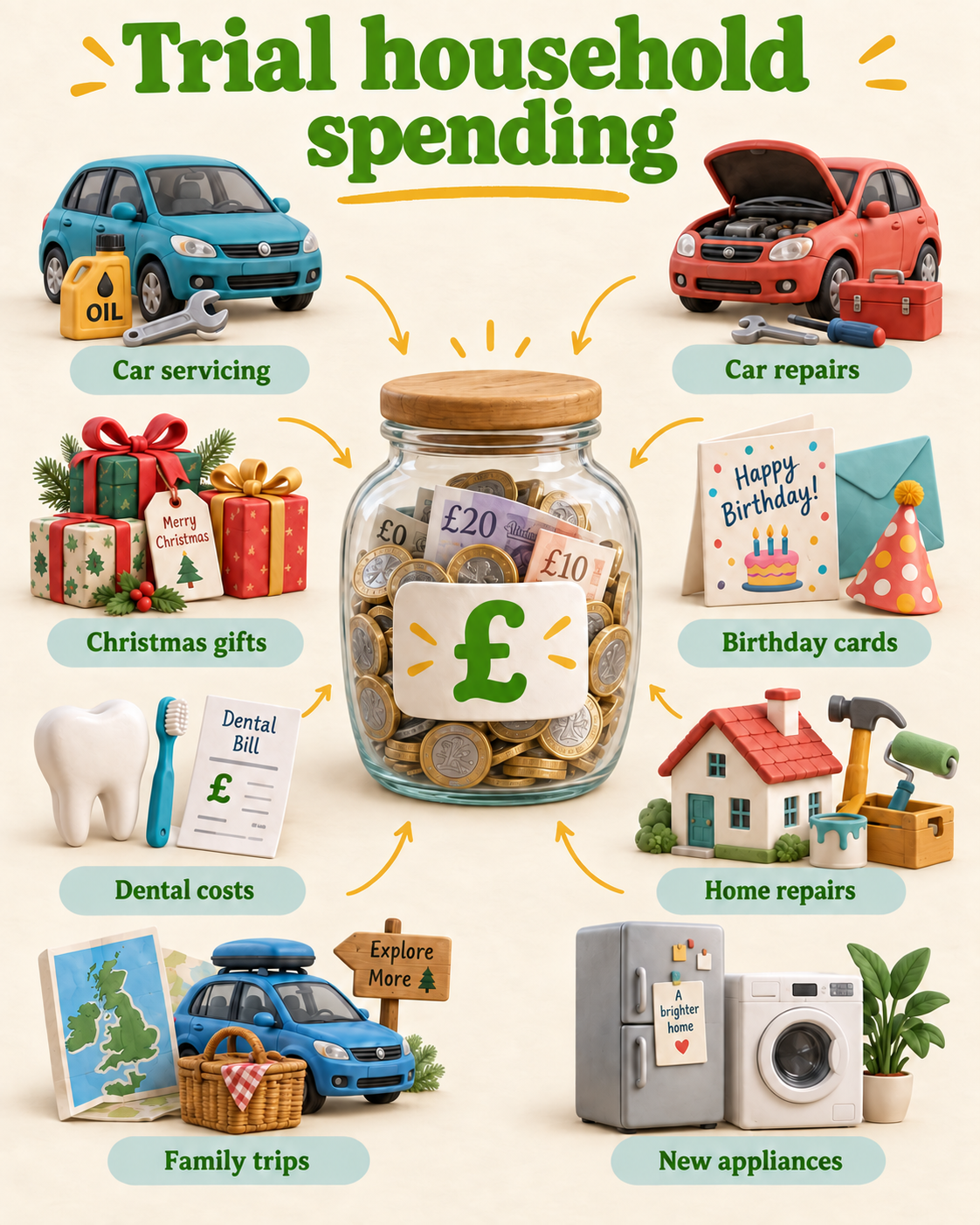
During the trial, include costs that do not arrive every month:
Car servicing and repairs
Christmas and birthdays
Insurance renewals
School or nursery expenses
Dental and optical costs
Home repairs
Family trips and days out
If the trial feels tight, that does not automatically mean the idea is impossible. It means you need to decide together what you are genuinely willing to change.
What UK financial support should you check?
There is no special “stay-at-home dad benefit”, but a change in household income can affect what your family is entitled to.
Use the government’s benefits calculators to check your circumstances rather than assuming you earn too much or will receive nothing.
You should also check:
Child Benefit
Universal Credit
Council Tax Reduction
Help with childcare costs
Support available through your local council
Childcare support and eligibility differ across England, Scotland, Wales and Northern Ireland. If you live in England, the government has a childcare support calculator. Recheck your entitlement before leaving work because some schemes depend on both partners meeting employment or earnings rules.
Rules and payment amounts change, so always confirm them using official guidance before making a financial decision.
Put Child Benefit in the right person’s name
This is an easy detail to miss and an important one to get right.
Only one person can claim Child Benefit for a child. The person registered for it normally receives National Insurance credits when the child is under 12. Those credits can help protect their future State Pension if they are not working or do not earn enough to pay National Insurance.
That means it may be sensible for the stay-at-home parent to be the person registered for Child Benefit.
Even if the higher-earning partner means your household is affected by the High Income Child Benefit Charge, you can still make a claim and choose not to receive the payments. This can preserve the National Insurance credits.
Read the current Child Benefit guidance and check your National Insurance record rather than discovering a gap years later.
What happens to your identity when you stop working?
Leaving work can feel strange even when it is completely your choice.
At work, you may have a job title, colleagues, targets and visible proof that you have achieved something. At home, you can work all day and still finish surrounded by toys, washing and a child asking for another snack.
You might miss your old life. That does not mean you regret becoming a stay-at-home dad or love your child any less.
When I stopped being “David the mechanic” and became known mainly as “Lily’s dad”, I had to work out who I was within that new life. Starting Old Dad Diary gave me a creative outlet and a way to document the time Lily and I were spending together.
You do not need to start a YouTube channel, blog or business. You do need something that still feels like yours.
That might be:
Exercise
Working on cars
Meeting a friend
Learning something new
Volunteering
Occasional freelance or part-time work
A hobby that has nothing to do with parenting
Being a devoted dad should not require erasing every other part of yourself.
Are you prepared for the isolation?
One of the biggest surprises can be the lack of adult conversation.
Many baby classes and toddler groups still have far more mums than dads. Most people will be welcoming, but being the only man in the room can occasionally make you feel as though you have wandered into the wrong meeting.
Do not wait until you are lonely to build a routine.
Choose a regular group, library session, swimming class or park visit and keep turning up. Familiar faces gradually become conversations, and conversations can become friendships.
Try to plan at least one piece of adult contact each week. A coffee, phone call or walk counts. Small connections make a considerable difference when most of your day is spent discussing snacks and whether trousers are really necessary.
How will staying at home affect your relationship?
When one partner earns the money and the other manages most of the childcare, resentment can build quietly on both sides.
The working partner may feel pressure to keep the household financially secure. The parent at home may feel that they never clock off and that their contribution is less visible.
Before making the change, talk about:
Who takes over when the working partner gets home
How nights and early mornings will be shared
Whether housework is automatically the stay-at-home parent’s responsibility
How each person will get time alone
How spending decisions will be made
Whether both partners will have access to personal money
What happens if either person becomes unhappy with the arrangement
Do not describe one person’s income as “their money”. It is supporting a family arrangement to which both partners are contributing.
Regular conversations are much easier than waiting until one of you is furious about a bin that has not been emptied.
Do you have a plan for your mental health?
Stay-at-home parenting can be rewarding, funny and full of moments you would otherwise miss. It can also be repetitive, exhausting and emotionally demanding.
You can love being with your child and still find the role difficult. Both things can be true.
Protective habits can include:
Getting outside every day
Having a loose weekly routine
Seeing other adults regularly
Exercising, even in short bursts
Sharing honestly with your partner
Keeping an interest that belongs to you
Asking for help before you reach breaking point
If low mood, anxiety, anger, hopelessness or feeling trapped continues, speak to your GP. Fathers and partners can experience mental health problems after becoming parents, and asking for support is not a failure.
If you need urgent mental health help, use NHS 111 online or call 111. If someone is in immediate danger, call 999 or go to A&E.
Do you need a plan for returning to work?
You do not need to decide exactly when you will return before you have even left. It is still worth discussing what you might want later.
Consider:
Whether you want to keep professional qualifications current
How you will describe the career break
Whether occasional work would help you stay connected
What skills you could learn from home
When you will review the arrangement
What will happen when your child starts nursery or school
A career break is not necessarily the end of a career. But pretending it will have no effect is not helpful either.
Give yourselves permission to review the decision after three months, six months and one year. Changing the arrangement later does not mean the original decision failed.
So, should you become a stay-at-home dad?
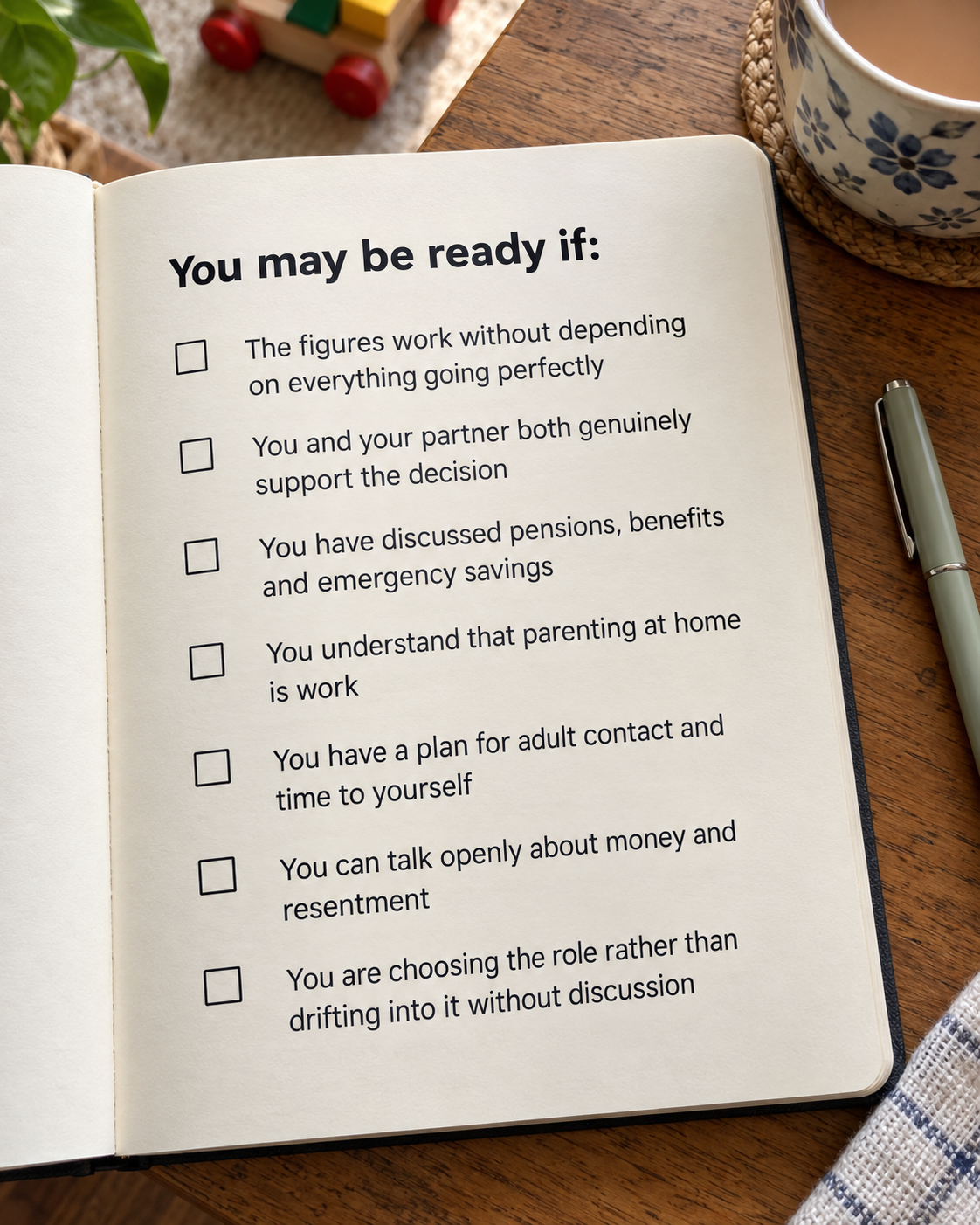
You may be ready if:
The figures work without depending on everything going perfectly
You and your partner both genuinely support the decision
You have discussed pensions, benefits and emergency savings
You understand that parenting at home is work
You have a plan for adult contact and time to yourself
You can talk openly about money and resentment
You are choosing the role rather than drifting into it without discussion
You do not need to feel completely certain. Most parents do not.
You need a workable financial plan, realistic expectations and permission to find parts of the experience difficult.
For us, having less disposable income was worth the time I gained with Lily. That does not make the decision right for every family but it made it right for ours.
For a much deeper look at daily routines, the first 90 days, mental health, activities and earning flexibly, continue with my complete UK stay-at-home dad guide.
Frequently asked questions
-
Compare your take-home pay with childcare and work-related costs, but also account for lost pension contributions, career progression and household resilience. Test living on one income before leaving work if possible.
-
There is no benefit specifically for stay-at-home dads. Depending on household income and circumstances, your family may qualify for Child Benefit, Universal Credit, Council Tax Reduction or other support. Use an official benefits calculator.
-
It can be sensible for the non-working parent to be registered for Child Benefit because the claimant normally receives National Insurance credits while the child is under 12. Check your circumstances with HMRC.
-
A career break can affect earnings, pension contributions and progression, but its impact varies. Keeping qualifications current, maintaining contacts and agreeing when to review your plans can make returning easier.
-
It can be. Regular parent groups, planned adult contact, exercise and interests outside parenting can help. Speak to your GP if isolation is affecting your mental health.
-
For many families, yes. It can create a close relationship with your child and remove the stress and cost of full-time childcare. It can also involve financial pressure, isolation and an identity shift, so the decision should be discussed honestly.
About Old Dad Diary
I’m David, a former Mercedes mechanic and now a full-time dad to Lily. Through Old Dad Diary, I share the honest reality of stay-at-home fatherhood—from toddler chaos and days out to money, identity and mental health.
